Trump, America, Qatar, and a Gas Deal Through 2054: What's the Strategic Play?
Qatar, one of the world's largest gas reserve holders, is buying American LNG through 2054. What does this surprising deal reveal about the future of global energy, oil and gas strategy, and competitive advantage?
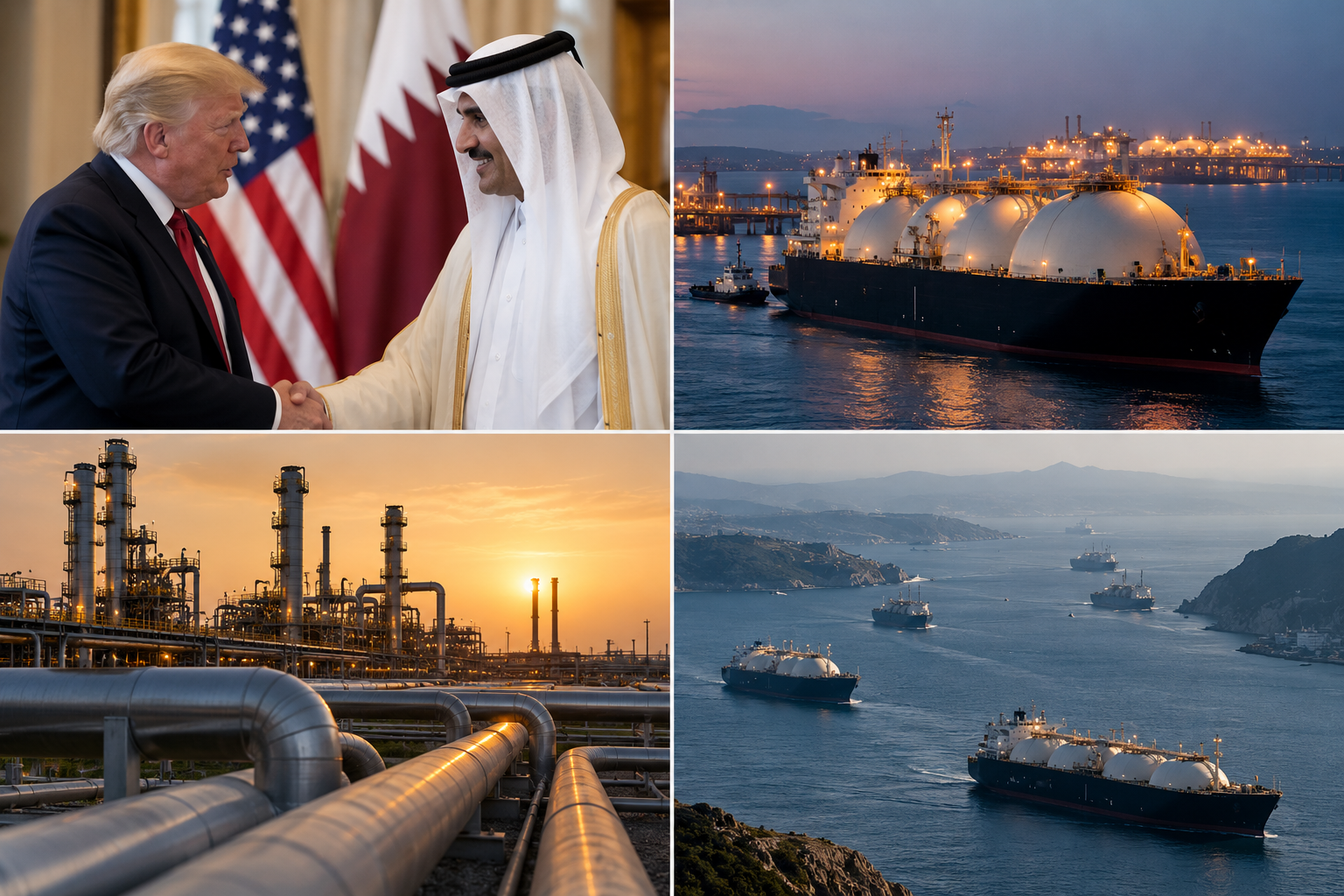
On 22 October 2026, QatarEnergy signed agreements to purchase up to 4 million tonnes of American liquefied natural gas (LNG) annually through 2054.
The agreements cover two facilities operated by Cheniere Energy: Sabine Pass in Louisiana and Corpus Christi in Texas. Deliveries are expected to begin in 2031.
Against the backdrop of President Donald Trump's energy agenda and the ongoing Middle East conflict, the announcement is striking.
Yes, Qatar is buying American gas.
Qatar, the world's third-largest holder of natural gas reserves and a leading LNG exporter, is securing supply from another major gas-exporting nation that runs for more than two decades.
Why?
And why now, when geopolitical tensions have disrupted the Gulf's energy infrastructure, threatened established supply routes, and raised fundamental questions about the reliability of global energy supplies?
Perhaps the answer lies less in how much gas Qatar possesses than in how reliably it can deliver gas to its customers.
Or perhaps something more far-reaching is unfolding.
When abundant natural resources are no longer enough
The current Middle East conflict has exposed a vulnerability that even the world's leading energy producers cannot ignore.
On 19 March 2026, Reuters disclosed that attacks on Qatar's Ras Laffan facilities had damaged two LNG production trains, representing 12.8 million tonnes of annual capacity, approximately 17% of its LNG export capacity.
At the same time, S&P Global Energy reported QatarEnergy's Chief Executive, Saad Al-Kaabi as saying that repairs could take three to five years, with potential consequences for long-term contractual deliveries to customers in Asia and Europe.
But the wider disruption is substantial.
According to the International Energy Agency's Gas Market Report, Q3 2026, LNG loadings from Qatar and the UAE plunged almost 80%, between March and June 2026 compared with the same period in 2025. A reduction of approximately 35 billion cubic metres.
This is no longer a hypothetical geopolitical risk.
It is a real disruption affecting physical assets, shipping routes, commercial commitments, and international gas markets.
Now consider Qatar's position.
A country possessing enormous gas reserves has suffered damage to its production infrastructure, while the region's principal maritime export route has also faced severe disruptions.
The gas may still be underground.
The contractual obligations may still exist.
The ability to deliver has become uncertain.
Could Qatar's American LNG purchases represent a strategic shift from securing gas resources to securing delivery capability?
That possibility deserves serious consideration.
Is Qatar protecting its contracts, or positioning for a different future?
QatarEnergy's official explanation provides an important starting point.
Announcing the Cheniere agreements, Al-Kaabi said the purchases would expand and diversify the company's global LNG portfolio, complement existing supplies, and strengthen its ability to serve customers worldwide.
The agreements provide for 2 million tonnes annually from each Cheniere facility, priced against the US Henry Hub benchmark plus a fixed fee.
One million tonnes from Sabine Pass remains conditional on a positive final investment decision for an expansion project.
The arrangement therefore offers more than additional volumes. It potentially provides a different production geography, different commercial pricing exposure, and greater flexibility in QatarEnergy's global supply portfolio.
But an intriguing timing question remains.
If the present crisis is driving the decision, why do deliveries begin only in 2031?
The estimated three-to-five-year repair period offers one possible explanation. Qatar may be accounting for the time required to restore damaged facilities and rebuild dependable production capacity.
Yet that cannot fully explain an agreement extending through 2054.
Perhaps the conflict has exposed vulnerabilities Qatar intends to address permanently.
Perhaps it wants to reassure international customers that it can secure alternative supplies when it matters.
Perhaps it sees opportunities to become an even more influential global LNG portfolio player, sourcing gas from multiple regions and serving customers wherever commercial opportunities arise.
Or perhaps all these considerations are operating simultaneously.
The distinction matters.
The new Cheniere contracts cannot directly replace volumes lost today, and their precise ability to support existing customer commitments will depend on commercial and logistical arrangements.
But the transaction may reflect lessons from today's disruption being incorporated into tomorrow's supply strategy.
Is Qatar responding to what has happened, preparing for what might happen again, or positioning for what the global gas business is becoming?
We do not know. And that uncertainty is precisely what makes the development strategically interesting.
Which future world is Qatar preparing for?
Consider the tension between geopolitical disruption and supply flexibility.
Imagine four possible operating environments.
A relatively stable world with concentrated supply. Production and export arrangements work efficiently, and diversification may appear unnecessarily expensive. But the apparent efficiency depends on continued stability.
A disrupted world with concentrated supply. Conflict, infrastructure damage, or shipping restrictions interrupt deliveries. Resource abundance offers limited protection when customers cannot receive contracted volumes.
A disrupted world with diversified supply. Alternative production locations, shipping arrangements, and commercial relationships provide options for maintaining deliveries, although at additional cost and complexity.
A relatively stable world with diversified supply. Geographical flexibility supports portfolio optimisation, market access, and trading opportunities, even without a major disruption.
These are not predictions. They are plausible futures for global oil and gas strategy.
The scenarios present different conditions under which a major energy supplier's commercial position could be tested.
In a stable world, energy supply diversification could enhance commercial reach and portfolio flexibility. In a disrupted world, alternative supply sources could become particularly valuable, subject to contractual and logistical arrangements.
But what if global gas demand weakens?
What if the cost of maintaining diversified supply exceeds its commercial benefits?
What if geopolitical risks shift to the new supply locations?
Diversification creates options. It does not eliminate uncertainty.
And that raises a larger question: how much should an energy company be willing to pay today for flexibility it may need tomorrow?
But there are more axes of uncertainties.
The geopolitical question does not stand alone. Additional tensions could materially change the attractiveness of Qatar's decision and the strategic choices facing other gas producers.
Consider these uncertain futures:
Demand remains strong while emissions requirements tighten, or demand weakens before major gas investments have paid back.
Could attractive gas prices coexist with expensive financing, forcing producers to choose between expansion, resilience, and capital preservation?
Will producers build the processing, transportation, and export infrastructure required to monetise gas before changing markets undermine the original investment assumptions?
These uncertainties suggest that the future of gas cannot be reduced to a single demand forecast or an assumption about the energy transition.
The choices being made today will have to survive several possible futures.
Could crude oil be next?
Oil and LNG have different logistics, market structures, and contracting practices. Their responses need not be identical.
But the underlying question is similar.
Could the ability to guarantee supply during disruption become an increasingly important basis of competition among the world's major energy exporters?
What should Nigeria be asking?
Nigeria's gas reserves are substantial.
According to the Nigerian Upstream Petroleum Regulatory Commission's 2025 reserves reporting, the country held approximately 210.5 trillion cubic feet of proved natural gas reserves as at 1 January 2025.
Yet the scale of the LNG industry reveals a striking contrast.
Nigeria LNG operates six liquefaction trains at Bonny Island, with an installed capacity of approximately 22 million tonnes per annum (MTPA). The Train 7 expansion is expected to raise that capacity to around 30 MTPA.
Qatar, by comparison, has 14 operational trains with an installed capacity of 77 MTPA, and plans to expand to 142 MTPA.
But the more consequential distinction may not be the size of their facilities.
Nigeria continues to face constraints in securing sufficient feedgas to utilise its existing liquefaction capacity fully.
Qatar, despite its much larger production base, is acquiring LNG from another continent, potentially strengthening its ability to serve international customers when domestic production or regional export routes are disrupted.
These are different strategic challenges, but they raise a common question:
What does it take to convert abundant gas resources into dependable commercial performance?
For Nigeria, that question deserves examination beyond production targets and expansion plans.
How resilient are our gas production, processing, transportation, and export systems to major disruption?
Are Nigerian gas-sector strategies sufficiently concerned with customer confidence, delivery assurance, commercial flexibility, and alternative routes to market?
And what capabilities would Nigerian operators need if global competition increasingly rewards suppliers that can maintain contractual performance under adverse conditions?
These questions are relevant not only to LNG exporters, but also to indigenous upstream operators, gas infrastructure developers, investors, and regulators.
Nigeria's strategic challenge extends beyond developing more gas resources. It may involve building the commercial, operational, institutional, and organisational capabilities required to monetise those resources reliably in an increasingly uncertain global market.
The question behind the deal
Qatar's agreement with Cheniere is not proof that the world will need more natural gas through 2054.
Nor is it proof that Qatar anticipates decades of geopolitical instability.
It may be a response to infrastructure damage, a measure to protect supply reliability, a commercial portfolio expansion, or a combination of several strategic considerations.
What makes the development significant is that these possibilities cannot yet be disentangled with certainty.
Other energy-producing nations face their own choices, often with incomplete information and competing interpretations of the future.
If Qatar, with its enormous gas reserves, sees value in securing American LNG for decades, what might that tell us about the future sources of competitive advantage in global energy?
And closer to home:
Is Nigeria preparing merely to produce more gas, or to compete successfully in the global energy industry that may be emerging?
The answers are not yet clear.
The questions deserve a place in today's strategic conversations.
About OGS Strategic Signals
OGS Strategic Signals examines consequential business and industry developments, the assumptions they challenge, and the strategic questions they raise for organisational leaders.
Related OGS Practice: Strategy Facilitation
An evidence-based baseline for the next investment decision, and the principal entry point to the Practice.
Enquire About Strategy Facilitation with OGS